The biggest unlock for technical organizations today isn’t a new tech stack or another reorg. It’s whether leaders can focus their engineering talent on the work that truly moves the business, and build the leadership depth to sustain that focus as they scale.
Wherever there is alignment, you can feel it: scattered engineering teams snap into clarity, growth markets get the attention they deserve, and future plant managers and technical leaders start to emerge from within the ranks. It’s a different level of performance. The hero capes come off, and it’s more team ball.
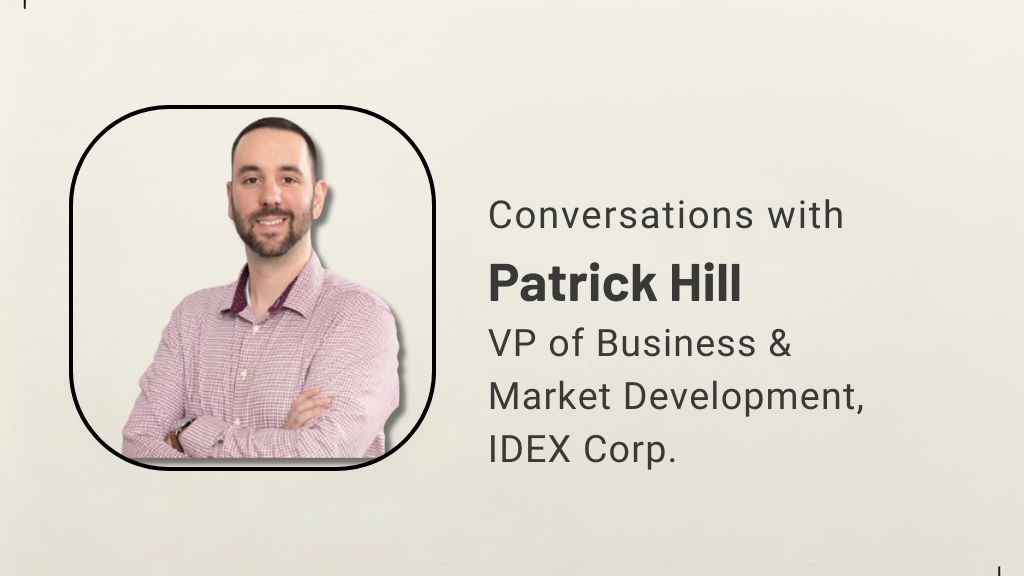
We sat down with Patrick Hill, Vice President of Business Development and Marketing Strategy at IDEX Mott Corporation, whose career spans commercial nuclear power, leading engineering and business units at Mott, serving as CTO, and now helping align the growth priorities of 25 companies under the IDEX umbrella. What stood out in our conversation is how deliberately he thinks about focus. The hyper-focus on where engineers spend their time, how communication reveals cultural health, and how AI and succession planning can be used as real leverage within org’s.
During our conversation, Patrick walked through the practical side of that: the career bets that moved him from individual contributor to enterprise leader, the simple signals he uses to read the health of multi‑site operations, and the very real ways AI is already making engineers 10x more effective – from removing writer’s block to deepening customer application understanding in real time. He shows that these aren’t abstract leadership ideas that any technical organization can use to build stronger teams with less chaos.
Please enjoy this latest issue of “Engineering 365.”
Shaun: You’ve gone from nuclear accident analysis at Westinghouse to CTO at Mott. Looking back, what were 2-3 pivotal moments that moved you from “the engineer” to owning the technical direction of the entire business?
Patrick: I’ll share two that were deliberate choices I made, and one that was a little bit of luck, because sometimes you do need luck in your career, too. So it’s important to acknowledge that. The first big move was at Westinghouse around 2015–2016. I volunteered for an expat assignment in Europe to lead a big portion of a project. It taught me a lot about how to work with people from different cultures and how to work across teams in matrixed organizations. It was an experience I would not have gotten staying home. I think it also accelerated my professional maturity just being in a different place and learning a new way of doing business. And so I think that was really pivotal.
If I could give my younger self advice, I’d say, “Sign up for more of those uncomfortable opportunities earlier.” They’re there, but you have to advocate for them.
The second pivotal choice I made was to join Mott. Mott, at the time I joined in 2017, was a small company, 100% employee-owned, fast and agile on a high-growth trajectory. And when I was looking to change the direction of my career, I was specifically looking for a fast and nimble place to work, which is what attracted me so much to Mott. And I think it was really pivotal to join and then be a part of that fast growth environment, which taught me a lot about how business operates, not just how engineering and engineering teams operate.
And then there’s the luck part. I joined the right company at the right time and had the right boss and mentor who advocated for me, who gave me growth opportunities, and who trusted me to go outside my comfort zone and learn and grow. That union – right company, right timing, right mentor – was an accelerator. Those three things together moved me from “the engineer” to the kind of work I get to do today.
Shaun: When you look across a multi‑site, even global, operation, how do you actually gauge cultural health and leadership strength? What are you paying attention to?
Patrick: I’d like to be more narrow on this question. I hope it’s okay. I’m going to give one cultural signal, and one leadership signal because I think both of these are so important. We could go through a list. But I think these two things, from my perspective, are really important.
Culturally, I start with a simple question: How are people communicating? If everything is happening by email, my blood pressure goes up.
A mentor at Mott taught me the importance of showing up when it matters. You can’t fly across the world for every meeting, but there’s a clear hierarchy for me:
- First: in‑person, when it really matters
- Second: live video, like this
- Third: Teams messages, phone calls
- Last: email
Email is where intent gets lost. If I see teams only communicating in email, I’ll literally say, “Pick up the phone. Stop the email chain.” How communication happens is a direct window into how the culture is working. Good or bad.
On the leadership side, I look very closely at what gets escalated and how. What shows up at the site leader? What makes its way to me? And are solutions coming with that escalation?
With my direct reports, we use two tools. One is the “zone of genius” idea. Everyone has something they’re the best in the world at, then a zone where they’re excellent, then areas where they’re just competent or flat‑out incompetent. I want my leaders spending as much time as possible in their genius and excellence zones.
The second is a very clear escalation plan. If you ask my team what must be escalated and in what timeframe, they can tell you. Safety issues? Within an hour, no excuses. Other issues? It depends on magnitude and severity—some should never leave the local level.
So I’m always asking: How are we communicating? What’s being escalated, with what urgency, and with what level of ownership? Those two lenses tell you a lot about whether decisions are being made at the right level, at the right speed.
Shaun: You’ve talked about AI making engineers 10 times more efficient, right? If we followed one of your engineers on your team right now through a typical day, where would we actually see that 10x show up? What are they doing differently compared to two years ago? And what’s your vision for where this is going over the next three to five years?
Patrick: Three to five years is almost too long. It feels more like three to five months, sometimes three to five weeks, with the rate of change in A.I. It’s one of the most exciting technical shifts of the last 100 years.
On the simple end of the spectrum, one of the most powerful uses is just killing writer’s block. Most engineers, myself included, aren’t naturally gifted writers. We’re math and science people. But we still have to write emails to customers and vendors, internal updates, and product development docs. Staring at a blank page can be paralyzing. A quick AI query can give you a draft or a structure that gets you moving again. It’s simple, but it gets you back to “talking the talk” much faster.
On the other end of the spectrum, AI is used as an accelerator for understanding customer applications. We’re solving problems across almost every major end market, for a wide range of customers, many of them high‑tech. The closer you get to understanding the customer’s process, the stronger your technical recommendation can be. While you’re talking, tools are working in the background, educating you on the customer’s process, the equipment, etc. That makes the engineer far more well‑rounded in the moment. You’re no longer limited to what you happened to learn earlier in your career.
So for me, the 10x shows up in three places. Removing friction from communication, collapsing the learning curve on customer applications, and offloading repetitive work.
You can listen to the entire conversation here: https://www.linkedin.com/events/7450182535944450048?viewAsMember=true
Need support when making a strategic hire across your manufacturing, sales, or engineering teams?
When you’re ready, here are two ways that we can help:
1. We’ll review your toughest workforce challenges and give you clear market insights to help you find the right solution.
2. Provide a zero-risk and no-cost assessment of your hiring strategies with a 15-minute conversation.
Is this post insightful? Show your support with a ‘Like’ and share the knowledge on LinkedIn, Facebook, and Twitter!